Bath textiles · Practical guide
A Practical Guide to Bath Towels: Weight, Absorbency, and Care
A bath towel is a small piece of everyday engineering. Fiber, weave, and weight determine how it meets wet skin, how quickly it dries afterward, and how it holds up to repeated washing. The right choice depends less on a single “best” specification than on how your household actually uses towels.
Published November 18, 2026
After a shower, a towel has one immediate task: take up water without feeling rough, heavy, or slow to dry. Yet towels that feel plush in a shop may behave differently once they are damp, washed, and hung in a crowded bathroom. A high pile can feel welcoming but hold moisture longer; a lighter weave may dry briskly but offer less enveloping softness. Even fiber labels tell only part of the story.
Understanding bath towels means looking at the whole fabric system: the fiber, the loops or weave, the amount of material packed into each square metre, and the conditions in which the towel will be laundered and dried. This guide explains how to compare those details, what weight can and cannot tell you, and how a few straightforward care habits help preserve absorbency and texture.
Start with the job the towel needs to do
A towel used after a quick morning shower has different demands from one shared by a family, carried to a pool, or kept in a bathroom with limited ventilation. Before comparing labels, consider the routine around it. How many times will the towel be used between washes? Is there a heated rail, an outdoor line, or only a narrow hook? Does it need to feel particularly soft, or is quick drying the priority?
These practical details matter because comfort and performance are not identical. A thick towel can feel substantial and absorb a generous amount of water, but it may also take longer to dry fully. A thinner towel generally uses less material and can be easier to launder and hang, though it may not have the cushioned feel some people prefer. In a humid room, or where several towels share a small rack, drying speed may be more important than maximum plushness.
Think of the choice as a balance rather than a contest. A useful towel should absorb effectively, feel comfortable against the skin, fit the available drying space, and remain manageable in your regular laundry cycle.
What towel weight means
Fabric weight is commonly shown in grams per square metre, abbreviated as GSM. It describes the mass of a square metre of fabric, not a direct measurement of softness, absorbency, or quality. As a broad guide, lower-GSM towels tend to be lighter and often dry faster; higher-GSM towels tend to feel thicker and more substantial. The exact experience still depends on fiber, yarn, pile, and construction.
- Lightweight towels are often easier to pack, store, and dry. They can work well in compact bathrooms, warm climates, or households that wash and reuse towels frequently.
- Midweight towels can provide a practical compromise: enough fabric for a comfortable everyday dry, without the bulk of especially heavy styles.
- Heavier towels may offer a plush, enveloping feel and a substantial hand. They need enough airflow and time to dry thoroughly, and they can take up more room in a washer and linen cupboard.
Use GSM as a comparison point, not a verdict. Two towels with the same stated weight can feel quite different because one may have a dense, tall pile while another has a flatter weave. Manufacturing methods and finishing also change the hand of the cloth. If possible, judge a towel by its construction and care requirements as well as its number.
Absorbency: fiber, loops, and surface
Absorbency is the towel’s ability to draw in and retain water. Cotton is widely used for bath towels because its fibers can take up moisture and its familiar looped construction creates a large surface area. But “cotton” alone does not guarantee a particular result. Yarn quality, pile height, density, and finishing all contribute to how quickly a towel wets out and how it feels during use.
In a conventional terry towel, loops rise from the base fabric. Those loops provide more surface area for contact with water and skin. A deeper, denser pile may feel soft and cushioned, while shorter loops can produce a flatter, more compact towel. The loop structure also influences drying: a fabric that holds more water after use can require more time and airflow before it is ready again.
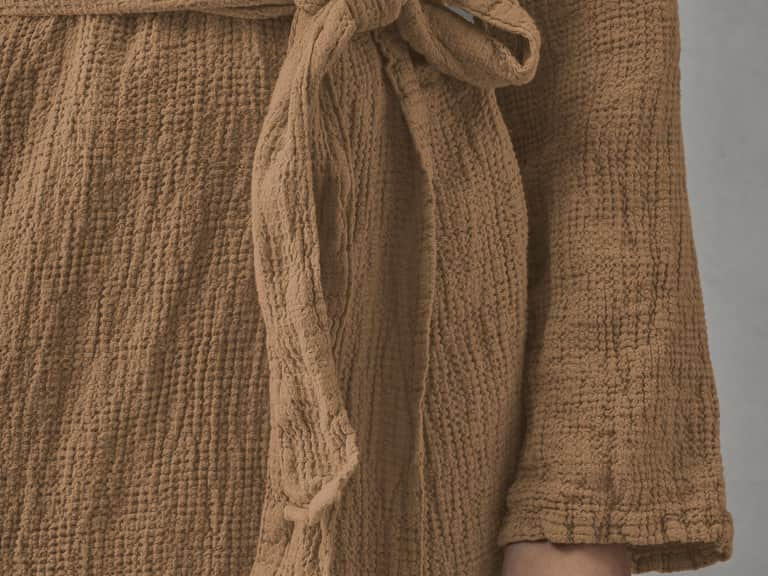
Some towels use a waffle weave, where raised cells and recessed channels create a textured surface rather than a thick field of loops. This construction can feel lighter and more open. For example, the [Lipe New Robe](/products/lipe-new-robe-5378) uses a 100% linen waffle weave at 230 g/m²; its product information describes the three-dimensional texture as supporting absorbency while keeping the garment light and quick to dry. A robe is not a bath towel, but the example illustrates how weave can shape the balance between texture, water handling, and drying time.
Other woven towels are relatively smooth and compact. Their feel and behavior depend on the particular yarn and weave, so a towel’s appearance alone cannot tell you precisely how it will perform. If absorbency is your chief concern, look for clear material and care information, and allow for the possibility that a new towel may behave differently after its first few washes.
Drying time is part of everyday performance
A towel’s life does not end when it leaves the bath. It must dry before it is used again, and how well it dries affects convenience, freshness, and laundry routines. A towel that stays damp for a long time may be uncomfortable to reach for and difficult to keep in rotation. That is why choosing a towel should include a realistic look at the bathroom—not just the moment it feels soft in your hands.
Air circulation is important. A towel spread across a wide rail dries more readily than one folded over a hook or bunched on a crowded bar. Open windows, an extractor fan, and a warm, well-ventilated room can help moisture escape. Where space is limited, a lighter towel may be easier to dry between uses, even if a heavier one feels more luxurious at first.
Household habits matter too. If towels are used once and washed, a slower-drying towel may be less inconvenient than it would be in a busy household where several people share a small rack. If towels are reused, hang them fully open and let them dry completely before the next use. A thoughtful rotation—enough towels to avoid overloading the wash, but not so many that unused textiles accumulate—can make upkeep simpler.
How to compare labels before buying
A useful towel buying guide begins with the specifications that affect real use. Read the care label and product description carefully, and compare like with like. A few points deserve particular attention:
- Fiber content: Check whether the towel is cotton, linen, or a blend. Fiber affects feel, moisture handling, and care needs.
- Fabric weight: Treat GSM as a guide to material density and likely bulk, not a promise of softness or performance.
- Construction: Note whether the towel is terry, waffle, flat woven, or another structure. Weave changes texture and airflow.
- Dimensions: Bath towels, bath sheets, and hand towels serve different needs. Make sure the size suits the user and storage space.
- Care instructions: Check washing temperature, drying guidance, and any advice to avoid softeners or bleach.
- Finishing and claims: Look for specific, verifiable information rather than assuming that words such as “natural” or “premium” describe measurable performance.
Consider the towel’s total footprint in your routine. A large bath sheet can wrap comfortably around the body, but takes more room in a washing machine and longer to dry. A smaller bath towel may be more practical for children, guests, or compact storage. The best size is the one that serves its purpose without becoming an awkward burden to wash and hang.
Why a new towel may not feel like an old favorite
New towels can feel stiff, unusually slick, or less absorbent than expected. Manufacturing finishes and residues from handling may affect the surface at first. A wash before use helps remove loose lint and prepares the fabric for regular service. Follow the maker’s directions, since temperature and drying advice can vary by fiber and construction.
Do not expect a towel to reach its settled feel in a single cycle. Washing and drying gradually change the fabric’s hand. Some towels become softer with use; others retain a firmer texture. Lint during early washes is common with many new textiles, but excessive lint that continues over time can suggest that the fabric is shedding more than expected. Wash new towels separately at first if you want to keep lint from transferring to other laundry.
Towel care: simple habits that make a difference
Good towel care is less about complicated products than about avoiding conditions that leave residue, damage fibers, or prevent thorough drying. Always begin with the care label. Then build a routine around a few dependable practices.
- Wash before first use. This removes surface residues and loose fibers, and gives the towel a clean start.
- Do not overload the washer. Towels need room to move through water and rinse properly. A crowded drum can leave detergent behind and make cleaning less effective.
- Measure detergent carefully. More detergent does not necessarily make a towel cleaner. Residue can make fabric feel coated and may affect how readily it takes up water.
- Use fabric softener sparingly, if at all. Coatings from softeners can build up on some towel fibers and reduce their ability to absorb water. Check the manufacturer’s instructions and your laundry product directions.
- Choose an appropriate wash temperature. Follow the label rather than automatically using the hottest setting. The right temperature depends on the fabric and the level of cleaning needed.
- Dry thoroughly without overdoing it. Air-drying can reduce energy use and wear, while a dryer can be convenient. Avoid excessive heat and follow the label; overdrying may leave towels rough and place unnecessary stress on fibers.
- Hang towels open between uses. Give the fabric as much surface area and airflow as possible. This simple step helps a towel dry more evenly.
If a towel feels stiff, first consider whether it has been overdried, washed in an overloaded machine, or exposed to too much detergent or softener. Adjusting those habits is usually a better first response than adding more products. For a persistent odor, wash towels promptly and ensure they dry fully; leaving damp textiles in a closed hamper or washing machine can make freshness harder to maintain.
Common towel myths, clarified
“The heaviest towel is always the most absorbent.” Weight indicates how much fabric is present, but absorbency also depends on fiber and construction. A heavy towel may feel plush and hold substantial moisture, yet a lighter towel can still absorb effectively.
“The softest towel will work best.” Softness is a comfort preference, not a complete measure of performance. Finishing can influence the hand of a new towel, and a very soft surface may not tell you how the fabric will behave after repeated laundering.
“More detergent means a cleaner towel.” Excess detergent can be difficult to rinse away, particularly when a washer is full. Residue may affect feel and performance. Use the amount recommended for the load size and water conditions.
“Every towel needs a hot wash.” Care requirements vary. Higher temperatures are not automatically better for every textile and can increase wear. Follow the manufacturer’s instructions and choose a wash cycle suited to the laundry.
A practical checklist for choosing bath towels
Before settling on a towel, pause over the details that will matter after the first week of use. This short checklist can help keep a purchase grounded in everyday needs:
- Does the towel’s size suit the person who will use it?
- Will it fit comfortably on your rails or hooks without bunching?
- Is its weight appropriate for your preferred feel and drying space?
- Do the fiber and weave match your priorities for texture and care?
- Can you follow the laundering instructions with your normal routine?
- Do you have enough towels for a useful rotation without overfilling storage?
For a household with limited drying room, a lighter or more open construction may be the sensible choice. For someone who values a cushioned, enveloping feel and has space to dry it well, a heavier towel may be more satisfying. If ease of care is essential, straightforward machine-wash instructions are worth prioritizing. A towel need not excel at every characteristic; it needs to perform well where your own routine puts it to work.
The long view: comfort through repeated use
Textiles are judged over time. A towel that remains comfortable after many wash cycles may be more useful than one that feels exceptional only when new. Longevity depends on the fabric and construction, but also on whether it is washed, dried, and stored appropriately. Avoiding unnecessary heat, excess detergent, and prolonged dampness helps reduce avoidable wear.
When towels begin to thin, lose their absorbency, or develop persistent odors despite careful washing and full drying, it may be time to reassess them. Until then, a simple care routine can keep everyday bath textiles working well. Wash them with room to rinse, dry them with airflow, and rotate them so no single towel carries the whole workload.
The most useful bath towel is not necessarily the thickest, softest, or most expensive. It is the one whose weight, absorbency, drying time, and care needs make sense in the place where you live. Compare the fabric honestly, pay attention to the wash label, and let your household’s rhythm guide the decision. The result is a more comfortable towel—and a practical choice that continues to make sense long after it comes home.